The Ultimate Guide to Commercial Termite Control Noida: Protecting Offices and Institutions from Silent Destroyers
The Ultimate Guide to Commercial Termite Control Noida: Protecting Offices and Institutions from Silent Destroyers
Estimated reading time: 10–15 minutes
Key Takeaways
- Termites are *silent destroyers* that pose a significant and costly threat to commercial properties in Noida, including offices and institutions.
- **Specialized commercial termite control** is essential due to the scale, complexity, and high stakes involved in business environments, differing significantly from residential pest control.
- Effective termite management relies on an **Integrated Pest Management (IPM)** approach, combining detailed inspections with targeted treatments like liquid termiticides, baiting systems, and direct wood treatment.
- All termite control operations must strictly adhere to **safety protocols** and comply with national (CIBRC) and state-level regulations, with a growing emphasis on *environmentally friendly* solutions.
- **Long-term protection** goes beyond treatment, requiring proactive measures such as moisture control, property maintenance, strategic landscape management, and crucial regular inspections and monitoring.
Table of Contents
- The Ultimate Guide to Commercial Termite Control Noida: Protecting Offices and Institutions from Silent Destroyers
- Key Takeaways
- Unmasking the Silent Threat to Your Business in Noida
- The Devastating Impact: Why Commercial Termites are a Unique Challenge in Noida
- The Critical Need for Specialized Office and Institutional Termite Solutions in Noida
- The Blueprint for Effective Commercial Termite Control in Noida: Processes and Methods
- Navigating the Regulatory Landscape for Professional Termite Control in India
- Beyond Treatment: Preventative Measures and Ongoing Monitoring for Long-Term Protection
- Conclusion: Safeguarding Your Investment with Expert Commercial Termite Control in Noida
- Frequently Asked Questions
Unmasking the Silent Threat to Your Business in Noida
Termites are often called "*silent destroyers*" for a very good reason. These tiny creatures can cause huge amounts of damage without anyone even noticing. They work quietly and out of sight, eating away at important structures and materials. By the time you spot them, the damage can already be extensive and very costly.
In Noida, commercial properties face a big threat from these pests. Places like offices, large warehouses, schools, and hospitals (which are *institutions*) are especially at risk. Termites can weaken buildings, destroy valuable assets, and stop businesses from running smoothly. This threat makes professional commercial termite control Noida a truly essential investment.
Businesses and *institutions* in this area face specific problems with termites. This means that regular pest control often isn't enough. You need special *office termite treatment Noida* and strong *institutional termite solutions* to truly protect your property. This guide will help you understand the termite threat, explore effective control methods, learn about important rules, and discover how to prevent future infestations.
The Devastating Impact: Why Commercial Termites are a Unique Challenge in Noida
Termites are more than just a nuisance; they are a major threat to any business or large organization. Their destructive power can lead to serious problems that affect your operations and finances. Understanding this impact is the first step in seeking effective *commercial termite control Noida*.
1.1. Prevalence and Economic Toll of Termites in India
Termites are a very common and costly pest all over the world, and India is no exception. People often call them "*silent destroyers*" because they can damage things for a long time without anyone noticing. This quiet damage can quickly add up. They feed on cellulose, which is found in many materials used in buildings, from wooden beams to paper documents.
*Commercial properties* are especially open to termite attacks. These buildings often use a lot of wood, paper, cardboard, and other materials that termites love to eat. Imagine a warehouse full of goods or an *office* with stacks of important papers – all potential food for these tiny invaders. The damage is not just to the structure of the building but also to what's inside.
The Indian Council of Agricultural Research (ICAR) and many university experts often point out the huge financial losses caused by termite infestations. Industries, farms, and city buildings all suffer. These losses can include structural harm to buildings, ruined goods in storage, destroyed important documents, and even damage to sensitive computer equipment in data centers. It is clear that these small pests have a very large economic impact.
1.2. Common Termite Species and Signs of Infestation in the Noida Region
In India, the most common and damaging type of termite is the subterranean termite. These *white ants* live in huge colonies deep underground. They need constant moisture to survive, which is why they stay hidden. To reach their food source above ground, they build special tunnels made of mud. These tunnels are often seen on walls, foundations, or wooden structures.
Spotting *signs of infestation* early is crucial for any business. Look for these common clues:
- Mud tubes: These are tiny tunnels, about the width of a pencil, that termites build to travel between their underground nest and their food source. You might see them on walls, doorframes, or foundation.
- Hollow-sounding wood: If you tap on a wooden doorframe, wall, or furniture and it sounds hollow, it could mean termites have eaten the inside.
- Discarded wings: Termites that are ready to start new colonies (called swarmers) fly out of the nest. After they find a mate, they shed their wings. You might find small piles of these discarded wings, especially near windowsills or light sources.
- Termite droppings (frass): Drywood termites, though less common than subterranean termites in India, leave behind tiny, pellet-like droppings that look like sawdust or fine sand.
- Damaged wood: Though often hidden, visible signs of damage include buckling wood or floors, maze-like patterns within walls or furniture, or areas that look water-damaged.
Recognizing these signs quickly means you can get professional *commercial termite control Noida* before the damage becomes too severe.
The Critical Need for Specialized Office and Institutional Termite Solutions in Noida
Termite problems in business settings are much more serious than those in homes. The size, complexity, and importance of *commercial properties* mean that *office termite treatment Noida* and *institutional termite solutions* require specialized knowledge and methods. This is not a task for general pest control.
2.1. Why Commercial Infestations Demand Professional Expertise
Controlling termites in a business environment, which is known as *commercial termite control Noida*, is much more involved and crucial than dealing with pests in a home. Several reasons explain this complexity:
- Scale and Complexity: Commercial buildings, whether they are large offices, sprawling warehouses, schools, or hospitals, are typically much bigger and more complicated than houses. They have multiple floors, different sections, complex electrical wiring, and often many hidden spaces. This makes finding every *termite colony* and treating the problem effectively much harder. An *infestation* can spread widely, affecting many different areas or departments within one large property. This vast scale requires expert assessment and a strategic approach.
- Operational Sensitivity: Unlike a home, a business cannot simply shut down for days for pest treatment. *Office termite treatment Noida* and *institutional termite solutions* must be carried out with minimal disruption to daily operations, staff, clients, or students. This requires careful planning and often specialized, low-impact treatment methods.
- Higher Stakes: The risks associated with termite damage in *commercial settings* are significantly higher. Structural damage can lead to huge financial losses, safety hazards, and harm to the company's reputation. This elevates the need for truly professional and reliable *pest management*.
2.2. Far-Reaching Consequences for Businesses and Institutions
The impact of a termite infestation in a commercial or institutional building goes far beyond simple property damage. These *silent destroyers* can disrupt operations, harm reputation, and even compromise safety.
- Operational Disruption: Termite damage can make parts of a building unsafe. This might mean *structural instability*, requiring very costly repairs. In severe cases, a business might have to close down some areas or even the entire building for a period. This can lead to a significant loss of income for *offices* and *institutions*. Imagine a school having to close classrooms due to unsafe flooring or an *office* losing access to critical departments. The disruption can be immense.
- Reputation and Safety: For businesses in sectors like hospitality (hotels, restaurants), healthcare (hospitals, clinics), or education (schools, universities), a visible *termite infestation* can severely damage their good name. Clients, patients, or students might lose trust if they see signs of pests. Furthermore, *structural damage* caused by termites can create direct safety hazards. Collapsing ceilings, weakened floors, or damaged staircases put employees, customers, or students at serious risk. Effective *institutional termite solutions* are absolutely vital for keeping everyone safe and maintaining public trust.
- Asset and Data Protection: Many *commercial entities*, including warehouses, *offices*, and *institutions*, store incredibly valuable items. This includes inventory, important legal documents, financial records, and critical IT equipment. Termites can destroy paper records, damage wooden shelving, and even chew through the insulation of electrical wiring, leading to electrical faults or fire risks. Losing vital paper records or suffering damage to expensive *IT infrastructure* due to *pest activity* can be catastrophic for any business. This highlights the crucial role of thorough *office termite treatment Noida* in safeguarding these invaluable assets.
The Blueprint for Effective Commercial Termite Control in Noida: Processes and Methods
Successful *commercial termite control Noida* is not a one-size-fits-all solution. It requires a carefully planned and executed strategy that goes beyond just spraying chemicals. The most effective approach involves a combination of methods, tailored to the specific needs of your *office* or *institution*.
3.1. Embracing an Integrated Pest Management (IPM) Approach
For any reputable *commercial termite control Noida* service, the gold standard is **Integrated Pest Management (IPM)**. This isn't just about using pesticides; it’s a smart, multi-step strategy focused on long-term solutions. IPM looks at the whole picture:
- **Prevention:** Stopping termites before they become a problem.
- **Monitoring:** Regularly checking for signs of termite activity.
- **Targeted Treatments:** Using a mix of methods, including chemical and non-chemical, to get rid of termites effectively.
- **Minimal Risk:** Choosing treatments that pose the least risk to people, pets, and the environment.
This comprehensive approach means less reliance on chemicals and a greater focus on understanding and managing the pest problem over time. It’s a sustainable way to protect your property.
3.2. Initial Inspection & Assessment: The Foundation of Success
The very first step in effective *commercial termite control Noida* is a detailed and thorough inspection. This is the bedrock upon which all successful *termite management* plans are built. Highly trained technicians are crucial for this stage.
During the inspection, specialists will:
- **Identify the species:** Knowing what type of *termite* (e.g., subterranean *white ants*) helps choose the right treatment.
- **Assess damage:** Determine how much damage has already occurred and where.
- **Locate entry points:** Find out how termites are getting into your building.
- **Understand conditions:** Look at the specific structure of your building and its surroundings (like moisture levels) that might attract termites.
For large *commercial properties* like *offices* and *institutions*, special equipment is often used to detect hidden activity. This can include:
- **Moisture meters:** To find areas of high moisture that attract termites.
- **Thermal imaging cameras:** To detect heat signatures from active termite colonies hidden inside walls.
- **Boroscopes:** Tiny cameras that can be inserted into small holes to inspect voids and hidden spaces without causing major damage or disruption.
This advanced assessment ensures that the *termite treatment* plan is precise and effective, directly addressing the problem at its source.
3.3. Targeted Treatment Methods for Lasting Office and Institutional Termite Solutions
Once the inspection is complete, a tailored treatment plan combining various methods is put into action. These methods are designed to provide long-lasting *institutional termite solutions* and *office termite treatment Noida*.
-
Liquid Termiticides (Chemical Barriers):
These treatments involve applying special liquids, called termiticides, to the soil around and under the foundation of your building. This creates a powerful, unseen barrier that termites cannot cross. Modern termiticides are usually non-repellent. This means *termites* don't avoid the treated soil. Instead, they unknowingly walk through it, pick up the chemical, and carry it back to their *colony*. This effectively transfers the treatment to other *white ants*, leading to the elimination of the entire colony over time. The application process must be very precise and follow strict safety rules, especially in sensitive *commercial areas* within Noida. -
Baiting Systems:
*Termite baiting systems* involve placing specially designed bait stations around the perimeter of your property. These stations contain a slow-acting insecticide hidden within a food source that termites find very attractive. Worker termites discover the bait, feed on it, and then carry the poisoned food back to their *colony*. The active ingredient then spreads among the other *termites*, eventually wiping out the entire *colony*. Baiting systems are often a preferred choice for sensitive *commercial environments* and *institutional settings* because they are less invasive and involve less chemical use directly inside buildings. This makes them ideal for spaces where minimal disruption is key. -
Direct Wood Treatment:
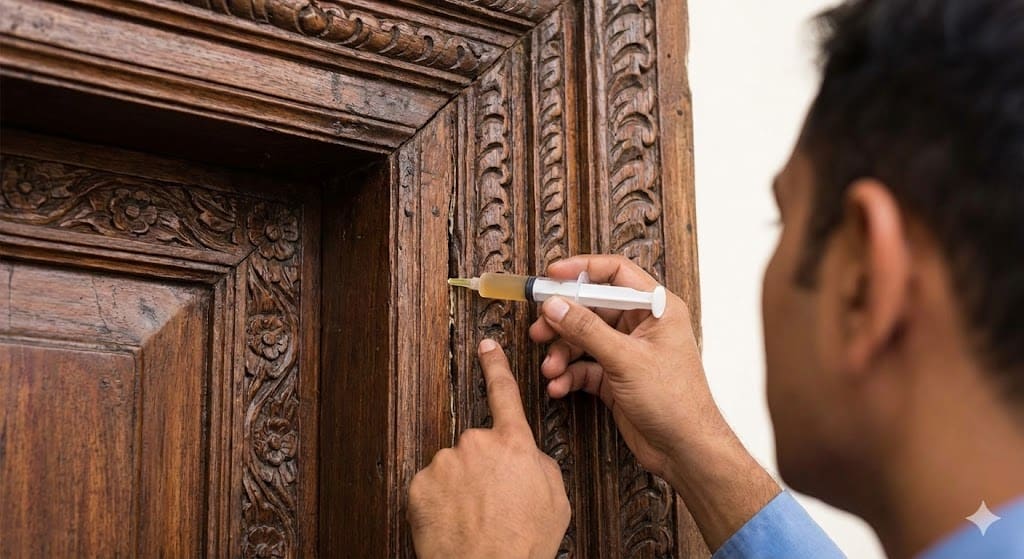
For existing *infestations* specifically within wooden structures (like beams, frames, or furniture), direct wood treatment is used. This involves injecting liquid termiticides or foaming agents directly into the infested wood. This method targets termites where they are actively feeding and damaging the structure. -
Pre-Construction Treatment:
For new *commercial constructions* in Noida, *pre-construction anti-termite treatment* is a crucial preventative step and is even required by law in many areas. This involves treating the soil thoroughly before the foundation of the building is laid. This creates a chemical barrier that protects the new structure from subterranean termites from the very beginning, offering long-term *termite protection* against future *infestations*. It's a smart investment for any new *business property* in the region.
3.4. Safety and Compliance: A Priority for Commercial Termite Control
When undertaking any *commercial termite control Noida* work, safety is the absolute top priority. This applies to everyone involved: your employees, your customers, and the environment. Professional *pest control companies* must ensure that all *termite management* is done safely and correctly.
This commitment to safety includes:
- **Approved Chemicals:** Only using pesticides that are approved by regulatory bodies and safe for commercial use.
- **Strict Protocols:** Following precise application guidelines to ensure the chemicals are used effectively and without harm.
- **Proper Ventilation:** Ensuring good airflow during and after treatments, especially in enclosed spaces, to protect occupants.
- **Minimizing Disruption:** Planning treatments to occur during off-hours or in stages to cause the least disturbance to your business operations.
Crucially, any *office termite treatment Noida* or *institutional termite solutions* must strictly comply with all local and national environmental and health regulations. This ensures responsible *pest management* that protects both people and the planet.
Navigating the Regulatory Landscape for Professional Termite Control in India
In India, *termite control* is a regulated activity to ensure safety and effectiveness. Businesses seeking *commercial termite control Noida* and *institutional termite solutions* should be aware of these rules and how they impact professional *pest management* services.
4.1. Central Insecticides Board & Registration Committee (CIBRC)
The **Central Insecticides Board & Registration Committee (CIBRC)** is the main regulatory body in India. It operates under the Ministry of Agriculture & Farmers Welfare. This important committee is responsible for:
- **Registration of Insecticides:** Ensuring that all pesticides used in the country are safe and effective. No *termicide* can be used in India without CIBRC registration.
- **Approval of Uses:** Deciding how and where these insecticides can be used. This includes specific guidelines for *commercial termite control Noida*.
- **Safety Guidelines:** Issuing clear rules for the safe handling, storage, and application of all registered *pesticides*.
When you choose a professional *pest control company*, it's vital that they only use CIBRC-approved products and follow all their guidelines. This ensures the treatment is both legal and safe.
4.2. State-Level Regulations for Pest Control Operators
While the CIBRC sets national standards for *pesticides*, individual states or Union Territories in India can also have their own additional rules for pest control companies. For example, Uttar Pradesh, where Noida is located, might have specific licensing requirements for *pest control operators*.
Professional *pest management companies* offering *institutional termite solutions* are expected to know and follow these local rules. This often includes:
- **Company Licensing:** Ensuring the company itself is properly licensed to operate in the state.
- **Technician Certification:** Making sure their technicians are trained, certified, and knowledgeable about specific local conditions and regulations.
Adhering to these state-level requirements ensures that the *termite control service* you receive is not only effective but also legally compliant and performed by qualified professionals.
4.3. Growing Emphasis on Environmental Considerations
There is a noticeable and growing focus in India, just like globally, on using *environmentally friendly* and less toxic methods for *pest control*. This trend encourages *commercial termite control Noida* providers to adopt solutions that have minimal impact on the environment.
This means that *termite management* is moving towards:
- **Eco-Friendly Products:** Using newer chemicals that break down faster or have a lower toxicity profile.
- **Integrated Pest Management (IPM):** As mentioned earlier, IPM reduces reliance on widespread chemical applications by focusing on targeted treatments and prevention.
- **Minimizing Ecological Impact:** Companies are encouraged to consider the broader environment and not just the immediate treatment area.
Businesses choosing *termite solutions* should look for providers who demonstrate a commitment to these *sustainable pest control* practices.
Beyond Treatment: Preventative Measures and Ongoing Monitoring for Long-Term Protection
While professional *commercial termite control Noida* is essential for dealing with existing *infestations*, preventing future *termite problems* is equally important. A proactive approach, combined with regular checks, ensures your *office* or *institution* stays free from *silent destroyers* for good.
5.1. Moisture Control: Eliminating Termite Attractants
Termites absolutely love moisture; it's vital for their survival. Reducing moisture around your property is one of the best ways to make it less attractive to *white ants*. Businesses should take these steps:
- **Fix Leaks Promptly:** Repair any leaky pipes, faucets, or roofs as soon as you find them. Even small drips can create enough moisture to attract termites.
- **Improve Drainage:** Make sure water drains away from your building's foundation. Standing water or soil that stays wet creates perfect conditions for subterranean *termites*.
- **Ensure Proper Ventilation:** Basements, crawl spaces, and attics need good airflow to prevent moisture buildup. Consider installing vents or fans if these areas are damp.
- **Keep Gutters Clean:** Clogged gutters can cause water to overflow and seep into your building's foundation, creating moist conditions that *termites* seek out.
These simple steps significantly improve the longevity and effectiveness of any *office termite treatment Noida* you might have received.
5.2. Proactive Property Maintenance
Regular maintenance of your property's structure and surroundings can go a long way in preventing *termite infestations*.
- **Seal Cracks:** Inspect your foundation and outer walls for any cracks or openings. Seal these immediately, as they can be easy entry points for *termite*s.
- **Repair Damaged Wood:** Replace or repair any water-damaged or decaying wood on your property. Termites are especially drawn to soft, rotting wood.
- **Proper Grading:** Ensure that the ground around your building slopes away from the foundation. This helps direct rainwater away, preventing it from pooling and keeping the soil dry.
5.3. Strategic Landscape Management
What's outside your building can also attract *termite*s. Smart landscaping choices are crucial for *termite prevention*.
- **Keep Wood Away:** Store firewood, lumber, or any wooden debris away from your building's foundation. If possible, elevate wood off the ground.
- **Mulch Management:** If you use mulch, keep it at least 6-12 inches away from your foundation. Mulch retains moisture, creating a perfect habitat for *termite*s.
- **Trim Trees and Shrubs:** Ensure that trees, shrubs, and other plants are not touching the exterior walls or roof of your building. Branches can serve as "bridges" for *termite*s to access your structure directly.
5.4. The Importance of Regular Inspections and Monitoring
Even after a comprehensive *commercial termite control Noida* treatment, the job isn't truly finished. Ongoing monitoring and scheduled follow-up inspections are absolutely vital for long-term protection. *Termite colonies* can be persistent, and new ones can emerge.
This proactive approach helps in several ways:
- **Early Detection:** Regular checks can spot any new *termite activity* or re-infestations at their earliest stages, making them easier and less costly to treat.
- **Continued Efficacy:** It ensures that the previous *termite treatment* is still working effectively.
- **Protection for Large Properties:** For big *commercial* or *institutional properties*, consistent monitoring is especially important to provide truly comprehensive *institutional termite solutions* across vast areas.
Investing in regular inspections means you're not just reacting to a problem, but actively safeguarding your valuable property against these persistent pests.
Conclusion: Safeguarding Your Investment with Expert Commercial Termite Control in Noida
Termites, those tiny yet formidable *silent destroyers*, present a significant and hidden danger to *commercial establishments*, *offices*, and *institutional properties* throughout Noida. The potential for *structural damage*, operational shutdowns, and severe blows to both finances and reputation highlights why ignoring these pests is simply not an option.
"Investing in expert termite solutions is not merely an expense; it is a critical, proactive step."
Effective protection against *termite infestations* demands more than just a quick fix. It requires professional, comprehensive *commercial termite control Noida* that strictly follows the principles of Integrated Pest Management (IPM). This means using a smart, multi-faceted approach focused on prevention, precise identification, targeted treatments, and minimal risk. Furthermore, any *termite management* strategy must comply with India's stringent regulations, including those set by CIBRC and state-level bodies, ensuring safety and legality.
Ultimately, investing in expert *office termite treatment Noida* and robust *institutional termite solutions* is not merely an expense; it is a critical, proactive step. It's about protecting your valuable assets, ensuring uninterrupted business operations, and maintaining a safe and healthy environment for everyone who steps through your doors – whether they are employees, customers, students, or patients. Choose professional *termite protection* to secure your investment and peace of mind in Noida.
Frequently Asked Questions
-
What makes commercial termite control different from residential?
Commercial termite control in Noida differs significantly due to the *scale and complexity* of properties (larger buildings, multiple sensitive areas), *higher financial stakes* (potential for huge losses, operational disruption), and *operational sensitivity* (minimizing interference with business activities). It requires specialized expertise and tailored solutions that go beyond typical home pest management.
-
What is Integrated Pest Management (IPM) and why is it important for businesses?
Integrated Pest Management (IPM) is a comprehensive, *multi-step strategy* for long-term pest control. It emphasizes prevention, monitoring, and targeted treatments, using a combination of chemical and non-chemical methods, with a focus on *minimal risk*. For businesses, IPM is crucial because it offers a sustainable, less disruptive, and more *environmentally friendly* approach to managing termites, protecting both property and people.
-
How often should commercial properties be inspected for termites after treatment?
Even after a thorough treatment, regular inspections and ongoing monitoring are vital for *long-term protection*. While the exact frequency can vary based on risk factors and previous infestation severity, many commercial properties benefit from *quarterly or bi-annual follow-up inspections*. Investing in a yearly *termite AMC* (Annual Maintenance Contract) is a smart way to ensure consistent monitoring and early detection of any new activity.
Get a Free Quote
Fill out the form below to request a free inspection or get a quote for our services.
More Articles Like This
Effective Rodent Control Noida: Your Guide to Professional Rat & Mice Removal Services
Termite Control Noida: Expert Solutions for a Termite-Free Property